Simulations will succeed, eventually
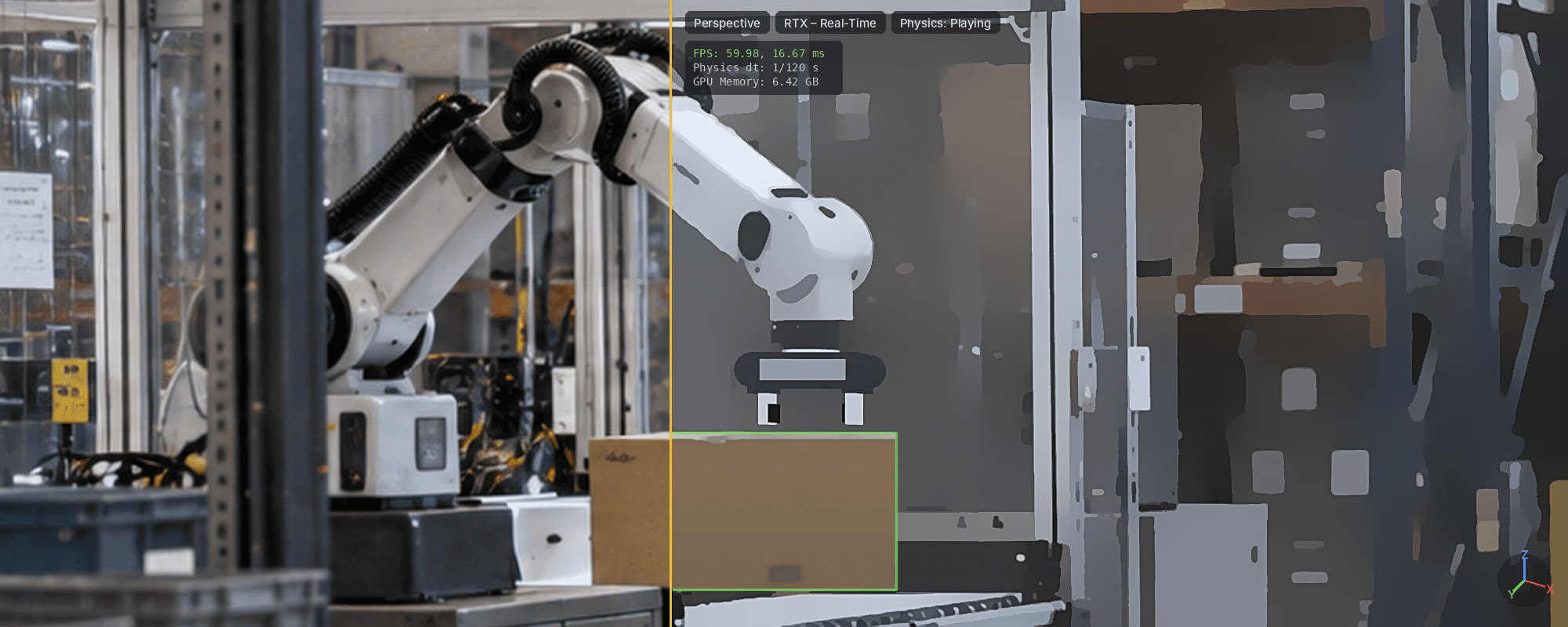
“Simulations are doomed to succeed,” Rodney Brooks, co-founder of iRobot, once said. He meant it as a warning: in a simulator, you can make anything work. Naive me interpreted it the exact opposite way. As a believer in the power of simulation, I assumed Brooks was on my side. Robotics will only reach real scale through simulation, so simulation is doomed to succeed, because we will simply have to make it work. (This is the level of reality distortion you need to keep your beliefs intact.) Brooks, I later realised, had abandoned my side. (Well, he was never on it.) I stuck to it anyway, and I’m still defiant: simulation is how robotics will scale.
I can already hear the alarm bells. What about the sim-to-real gap? Contact physics? Solvers you can’t trust? Deformable objects? Tendon-driven hands? Policies that don’t transfer? I’ve talked to dozens of robotics teams over the past few weeks, and every one of them raised some version of this list. I agree with all of it. Today’s simulation infrastructure has real problems that no one has fully solved. I just don’t agree that because it has problems, it can’t be useful.
All models are wrong, some are useful
The automotive and aerospace industries run on simulation. Crash, structures, CFD, thermals: most of the engineering happens inside a simulator long before a prototype exists. Imagine crashing hundreds of prototype cars to get a five-star safety rating. Yet ask any simulation engineer in those teams and you’ll hear the same complaints robotics people make. I know, because I was one of them. They don’t say “sim-to-real,” but they talk about correlation gaps and how painstaking it is to build a good model. But they would never dream of working without one.
Outside traditional engineering, the clearest example today is self-driving. Waymo says its system reviews millions of real miles driven each week “and tens of billions in simulation.” Sit with that for a second. For every mile a Waymo drives on a real street, it drives many more in a copy of the world. That’s what useful simulations look like at scale.
When intelligence is common
Right now, robotics is racing for data. Say that race is won, and foundation models become an API call away. Intelligence becomes common, and the edge moves to what you do with it: how fast you find and fix failures, how far you can optimise your policies, and how you cover the situations where no human data exists. The team that answers those questions fastest wins the deployment game, and that speed will run on simulation. Formula 1 already knows this: it rations CFD time and gives the least to last season’s champion. Simulation is such an advantage that the sport has to handicap it. And for robots that must be faster than any human, or work where no human can safely go, simulation is the only way.
The missing loop
Most teams already see the power of simulation. So why hasn’t simulation caught up with reality? Like most modern problems, I believe the answer is data and how we use it. Every deployment produces exactly what a simulator needs to get better, but we haven’t built scalable systems that use it. Keeping a simulation in step with reality is a constant, manual effort, and most simulation teams end up playing catch-up. What we need are systems and tools that make it easy for them to turn test and deployment data into better simulations.
Where Trekion comes in
That is what we are building at Trekion: helping teams build useful simulation for robotics.
We will build, or help you build, the worlds your robots learn in and the assets they handle, plus the eval and failure suites that show their limits. We will calibrate each robot’s twin to match reality. And most importantly, we will help you use your test and deployment data to keep tuning your simulations, because the first version won’t make the cut. Every success and every failure flows back into the simulation and makes it a little more true, and your trust in sim keeps growing.
This is the promise of Trekion. Not perfect simulation. Useful simulation, improved continuously. And if we keep at it consistently, who knows, we might just achieve perfection as well.
Simulation is doomed to succeed, because that is the best way for robotics to scale.
Building robots for warehouses or factories?
We turn real facilities into simulation your policies can be proven in.
Request access